
Cold saws are a strong choice when a shop needs square, repeatable metal cuts with relatively little burr and less secondary finishing. With the right blade, cutting conditions and workholding, they can help prepare consistent blanks for fabrication, machining, assembly and mandrel tube bending.
The benefit is not simply a better-looking cut. It is less time correcting cut faces, more predictable fit-up and a more consistent starting point for the next operation. A cold saw still needs proper setup, and a freshly cut tube still needs inspection, deburring where necessary and cleaning.

Why choose a cold saw for precise metal cutting?
A cold saw uses a toothed circular blade to remove metal as chips rather than grinding through it with an abrasive wheel. Correct blade selection, speed, feed and lubrication help manage friction and heat. On a suitable application, this produces a controlled cut with a relatively smooth face and limited burr.
“Cold” does not mean the blade, chips or workpiece remain at room temperature. Cutting still generates heat. Compared with abrasive cutting, an appropriate cold-saw process can reduce thermal effects and abrasive dust, but it is not a promise of zero heat, zero sparks or a burr-free edge.
Once the stock support, vise, cut angle and length-setting method are established, the process can produce consistent blanks. That matters for tube assemblies, frames, brackets and repeat-length components where variation creates extra work downstream.
How a cold saw works: low speed, controlled cutting and chip removal
Low RPM and high torque for appropriate steel-cutting applications
Instead of relying on the high rotational speed of an abrasive cutoff wheel, a conventional steel-cutting cold saw uses a comparatively slow-turning toothed blade and a drive designed to provide cutting torque. Each tooth removes a chip as the blade advances through the stock. The correct speed depends on the material, blade diameter, tooth design and machine—not a single RPM range that applies to every cold saw.
For manual and semi-automatic steel-cutting work, evaluate the Pedrazzoli Super Brown 350/60 MRM and 350/60 SA. Aluminum and other non-ferrous applications may require substantially higher blade speeds and a different machine configuration, such as the Perris range discussed below.
A toothed blade cuts chips rather than grinding away the stock
Circular metal-cutting systems can use solid high-speed steel (HSS) or carbide-tipped blades, depending on the approved machine and application. These blade types are not automatically interchangeable. Confirm the blade specification with CML USA before selecting a blade for your Pedrazzoli saw.
Chips carry away a substantial portion of the cutting heat. Combined with suitable cutting conditions, this can reduce the discoloration and thermal effects associated with abrasive cutting. It does not eliminate heat: the workpiece, blade and chips can still be hot, and freshly cut edges can still be sharp.
Coolant and lubrication support the cutting process
Where specified, the saw’s coolant system delivers cutting fluid to help lubricate the cut, manage heat and clear chips from the cutting area. Proper fluid selection, concentration and maintenance support cut quality and blade service life. Coolant does not compensate for a dull blade, unsuitable tooth pitch or poor workholding, and chips may still need to be removed using the prescribed safe cleaning procedure.
What is a manual cold saw?
A manual cold saw is an operator-fed circular metal-cutting machine: the motor turns the toothed blade while the operator controls the cutting-head feed and positions the stock. A conventional coolant-equipped steel-cutting model combines comparatively low blade speed with rigid workholding. “Manual” describes the cutting cycle, not a hand-powered blade.
For varied fabrication work and smaller batches, consider the Pedrazzoli Super Brown 350/60 MRM. Evaluate its manual head control, quick-lock vise, coolant equipment and adjustable miter head against your actual parts. The published variable-speed version has a 15–90 RPM range; confirm the speed options and electrical configuration of the machine quoted rather than applying a generic 20–120 RPM figure.
- Head control: check handle reach, operator effort and controlled feed throughout the cut. Follow the machine’s operating procedure; trigger arrangements differ by model.
- Coolant: verify the supplied system, fluid requirements, chip management and routine maintenance.
- Workholding: assess how the vise grips your section without movement or unacceptable distortion. Do not assume every manual saw clamps on both sides of the blade.
- Miter capacity: check left- and right-hand angle limits and the capacity chart at the actual cut angle. A 45-degree capability does not imply identical capacity or travel in both directions.
- Production volume: include stock loading, positioning, clamping, cutting and cleanup in the time per finished part. Compare a semi-automatic cycle when repetitive manual head feeding becomes a production constraint.
Abrasive cutoff wheels remove material by abrasive action, not simply by “melting through” the metal. A suitable toothed cold-saw setup can reduce heat effects and finishing work, but still requires edge inspection, any necessary deburring and safe handling. Aluminum and other non-ferrous applications need their own approved machine, blade and speed selection.
What is a semi-automatic cold saw?
A semi-automatic cold saw uses powered workholding and a controlled saw-head cycle while the operator normally loads, positions and unloads the material. The motor drives the toothed circular blade; pneumatic or hydraulic systems may control the cutting cycle, depending on the machine. The Pedrazzoli Super Brown 350/60 SA uses adjustable pneumatic downfeed and return with pneumatic workholding.
How does the semi-automatic cutting cycle work?
In a typical application, the operator supports and positions stock to the required length, clears the guarded cutting area and initiates the approved cycle. The machine clamps the stock and carries out the controlled cut and head return. The precise order of blade start, clamping, return and vise release—and whether a button, pedal or another control is used—must follow the supplied machine’s manual. This overview is not an operating procedure.
Why choose controlled feed instead of manual head feeding?
A powered head cycle can reduce repeated physical effort and help make cutting feed more consistent across a batch. It does not make the saw immune to blade damage: excessive feed, unsuitable speed or tooth pitch, poor clamping and worn blades can still cause problems. Set the machine for the actual material and inspect the first part and subsequent production cuts.
Does semi-automatic mean automatic feeding to length?
No. The base 350/60 SA cutting cycle and the optional PD100 automatic feeder are separate functions. The feeder adds programmed stock positioning and is quoted separately. The Super Brown 350 AP is another automatic option with a step feeder. Confirm loading, cut-length range, material support, clamping and saw/feeder integration for the complete system; automatic feeding does not mean unattended loading.
Compare manual and semi-automatic saws using total time per acceptable part, not only blade-in-cut time. Include loading, measuring, positioning, clamping, the cutting cycle, unloading, inspection and any cleanup.
Industrial cold saws versus dry-cut metal chop saws
The names “cold saw,” “cold-cut saw” and “dry-cut saw” are sometimes used for different types of equipment. A traditional industrial steel-cutting cold saw commonly combines a relatively low blade speed with coolant and rigid workholding. A purpose-built dry-cut metal chop saw commonly uses an approved carbide-tipped blade at a higher rotational speed, without flood coolant.
Do not treat those machines, blades or operating instructions as interchangeable. Compare the actual material ratings, blade speed, workholding, miter accuracy, duty requirements and complete cut quality. A portable dry-cut saw may suit some job-site work; a stationary Pedrazzoli Super Brown is worth evaluating for controlled shop cutting, repeated blanks and the appropriate manual or powered cutting cycle.
Does a cold saw guarantee a burr-free, cool-to-touch cut?
No. A correctly selected cold saw can reduce burrs, heat discoloration and finishing work compared with abrasive cutting, but “cold” is a process description, not a handling-temperature guarantee. Check the inside and outside edges and remove remaining burrs before bending, welding or assembly. A smooth-looking finish does not establish a specified surface roughness, squareness or length tolerance; verify the finished part against the drawing.
Does a cold saw eliminate sparks, noise and dust?
Toothed cutting avoids consuming an abrasive cutoff wheel and generally reduces its characteristic spark shower and abrasive-wheel dust. It still creates sharp chips, noise and potentially coolant mist; sparks can occur under unsuitable conditions. Keep guards in place, use the prescribed eye and hearing protection, and follow the machine’s chip-removal, coolant and safe-stop procedures.
No cutting process makes a freshly cut part automatically safe to touch. Check temperature and sharp edges and follow the machine’s handling instructions.
Cleaner cuts can mean less finishing work
Every cut that needs additional squaring, heavy deburring or fit-up correction consumes labor. Reducing those operations can be valuable even when a different process offers a lower initial equipment cost.
A controlled saw cut can help with:
- Fit-up: more consistent contact between mating parts.
- Blank preparation: repeatable lengths for later machining or bending.
- Assembly: fewer corrections caused by uneven or inconsistent cut ends.
- Handling: less burr to remove before material moves to the next station.
- Process consistency: a more predictable starting condition for repeat jobs.
Do not assume that a smooth-looking cut is automatically ready for welding, brazing or coating. Remove cutting fluid and contamination as required, and follow the applicable edge-preparation and joining specification.
Key cold saw benefits for a fabrication shop
- Clean, square ends with minimal burring: a correctly set up cold saw can produce a smooth, mill-like cut face and reduce heavy cleanup. Check length, squareness and both tube edges; deburr whenever necessary.
- Less abrasive-cutting heat, sparks and dust: chip-forming cutting avoids the abrasive wheel’s grinding action. It can reduce the shower of sparks and abrasive-wheel dust, but it does not eliminate metal chips, all sparks, noise or other hazards. Use the required guarding and protective equipment.
- More consistent preparation: a square reference end and repeatable blank length can make welding fit-up, assembly and tube-bending preparation more predictable.
- Miter-cut capability: a suitable head or vise arrangement produces angled ends for frames, stairs and railings, including assemblies that are mitered rather than bent. Confirm the selected model’s angle limits and capacity at the required angle.
- Serviceable blade options: suitable HSS blades can often be professionally resharpened, helping manage tooling cost over their service life. Reconditioning depends on blade condition and the supplier’s limits.
Common applications: tube, pipe, profiles and bar
A properly selected Pedrazzoli cold saw can support fabrication, industrial manufacturing, maintenance, automotive fabrication and weld preparation. Match the exact model and setup to the job:
- Steel pipe and structural tubing: square, round and rectangular blanks for handrails, frames, brackets and bent assemblies.
- Stainless steel: applications requiring a suitable blade, cutting speed, feed and lubrication—not an unchanged mild-steel setup.
- Angle, channel and solid bar: sections within the machine’s published material and shape capacities, securely supported and clamped. A tube capacity is not a solid-bar rating; do not assume heavy structural sections or I-beams fit merely because the saw is described as industrial.
- Aluminum, copper, brass and other non-ferrous alloys: application-specific machine and blade selection. Ask CML USA about the appropriate Perris configuration for aluminum and confirm suitability separately for other alloys.
How the blade and cutting setup affect the result
The blade, material, tooth pitch, feed and cutting speed work together. A good saw with an unsuitable blade or poor clamping can still leave a rough face, excessive burr or damaged teeth.
- Machine compatibility: use the specified blade diameter, bore, drive-hole pattern, thickness and speed rating.
- Tooth selection: match the pitch and geometry to material, wall thickness and section. Thin-wall tube needs a suitable tooth-engagement pattern—not simply the largest available tooth count.
- Feed: use the manufacturer-recommended feed for the blade and material. Excessive feed can overload teeth; insufficient feed can cause rubbing.
- Workholding: prevent movement without crushing thin-wall tube.
- Stock support: support long material so its weight does not pull the work out of alignment.
- Cooling and lubrication: use the system, fluid and maintenance procedure specified for the machine and material.
Steel-cutting cold saws and high-speed saws for aluminum can use substantially different operating conditions. Do not transfer a speed or blade recommendation from one application to the other. For detailed blade selection and maintenance, read Cold Saw Blades: Selection, Care and Sharpening.
Match automation to the workload
Manual: varied work and smaller batches
A manual saw can be a practical choice for maintenance, prototypes and fabrication work with frequent changes. The operator controls the head movement, and setup remains important to repeatability.
The Super Brown 350/60 MRM is Pedrazzoli’s manual cold-saw example. Its published features include a manual quick-lock vise, a micrometer-adjustable stock stop, a coolant system and mitering capability. Confirm capacities and options for the application.

Semi-automatic: repeated cutting with less manual head operation
A semi-automatic cycle can reduce repetitive operator actions while the operator continues to position or feed the material as required. It does not automatically include stock feeding.
The Super Brown 350/60 SA offers a semi-automatic cycle with pneumatic workholding. Its published anti-burr arrangement supports the part during cutting to help minimize burring. This is not an internal tube-deburring system, and it does not remove the need to inspect the tube mouth.
Automatic: repeated blanks with material feeding
An automatic saw can be worth evaluating when repeated lengths and sustained output justify the equipment and setup. Verify feeding range, allowable cut lengths, remaining stock, material support and the operator’s actual duties.
The Super Brown 350 AP combines automatic operation with a feeder and pneumatic vise. Request a trial using your stock and required cut lengths rather than assuming that every short blank or batch pattern is supported.

For aluminum, evaluate the appropriate high-speed saw
Aluminum and other non-ferrous sections require their own blade, speed, lubrication and workholding assessment. Do not assume a machine and setup selected for steel should be used unchanged.
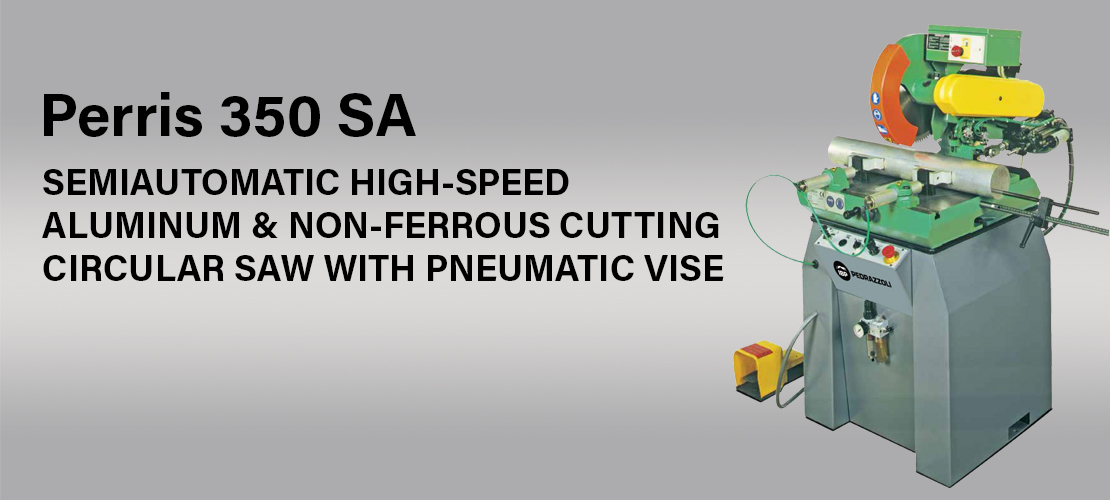
The Perris 350 SA is published as a semi-automatic high-speed circular saw for aluminum and non-ferrous cutting. Evaluate it for suitable profiles and sections rather than treating it as an interchangeable steel-cutting configuration.
Why a cold saw is useful before mandrel tube bending
A mandrel supports the tube internally during bending. The tube must load over that tooling without interference from an inward-facing burr, a distorted mouth or loose debris.
A properly selected cold saw can provide square, consistent blanks with relatively little burr. That makes it a useful first step in a controlled tube-preparation process—but not the final step.
Internal burrs deserve particular attention
An internal burr can catch on the mandrel, increase loading resistance, scratch tooling or the tube bore, or break off and introduce debris. An external burr can interfere with locating surfaces and create a sharp-edge hazard. Inspect both edges, not just the visible outside lip.
Where the tube end locates against a stop, an uneven cut can also affect its position. Establish the required cut length and squareness from the part drawing and process plan.
A practical preparation protocol
- Verify the blank requirements. Confirm material, outside diameter, wall, cut length and any gripping or trimming allowance.
- Cut with an approved setup. Support the stock, clamp it without unacceptable distortion, and check the first cut for length and squareness.
- Deburr inside and outside. Remove projections with suitable tools. Use the specified edge break; do not remove excessive wall material or create a large chamfer to disguise a fit problem.
- Remove chips and unwanted residue. Use an approved cleaning method that removes debris rather than pushing it farther into the tube.
- Inspect the prepared blank. Check the bore, tube mouth, dimensions and cleanliness. Do not use a bare finger to feel for sharp burrs.
- Lubricate as specified. Apply the bending lubricant in the approved areas. Do not contaminate gripping surfaces indiscriminately.
- Load using the approved bender setup. Unexpected resistance requires investigation. Never use extra machine force to overcome an unexplained obstruction.
- Inspect the first bent part. Verify drawing requirements and repeat checks after relevant material, tooling or cutting-process changes.
Key distinction: a saw’s anti-burr workholding helps control burr formation during cutting. Deburring removes a remaining burr. Cleaning removes loose contamination. These are different functions.
This is general preparation guidance, not a machine operating procedure. Follow the manufacturer’s guarding, safe-stop and energy-isolation instructions before accessing tooling or clearing chips. Mandrel position, pressure-die settings and other bending parameters require an approved application-specific setup.
For the next stage of production, read the Full-Electric CNC Tube Bender Buyer’s Guide. If the tube also needs a connection feature, see the Tube End Forming Machine Buyer’s Guide.
How cold saws compare with other cutting options
| Cutting process | Useful applications | What to evaluate |
|---|---|---|
| Cold saw | Repeatable shop cutting of suitable tube, profiles and bar | Cut quality, section capacity, blade selection, workholding and preparation time |
| Band saw | Varied stock and larger sections within the chosen machine’s range | Blade selection, squareness, finish, cycle time and automation |
| Abrasive cutoff saw | Suitable rough-cutting and portable applications | Heat, burr, sparks, dust and downstream finishing requirements |
| Purpose-built handheld metal-cutting circular saw | Compatible field work or portable straight cutting | Approved blade and material, guides, support, guarding and achievable accuracy |
A metal-cutting blade does not make an ordinary woodworking saw suitable for metal. Use only a machine-and-blade combination approved for the application. Abrasive cutoff wheels and toothed cold-saw blades are not interchangeable.
A band saw can also produce acceptable blanks for mandrel bending when the resulting length, squareness, edge condition and cleanliness meet the process specification. For a fuller equipment comparison, read Cold Saw vs. Band Saw.
Keep cut quality consistent as the blade wears
Resharpen suitable HSS blades instead of treating every blade as disposable
A solid HSS cold-saw blade can often be resharpened several times by a qualified blade service, provided its condition and remaining dimensions allow it. This can be an ownership-cost advantage compared with consuming disposable abrasive wheels. There is no universal number of sharpening cycles, and damaged teeth, cracks or an unsuitable remaining diameter may require replacement.
Have the blade service assess tooth geometry, pitch, tooth condition and compatibility after regrinding. Carbide-tipped blade servicing has different requirements and should be assessed separately. Never continue using a damaged blade simply because it has not yet reached an expected sharpening count.
Watch for increased burr, roughness, chatter, unusual noise or excessive cutting effort. These can indicate blade wear, an incorrect setting, poor clamping or another condition requiring attention. Stop safely and investigate rather than increasing feed to compensate.
Maintain the coolant system where fitted, follow the blade supplier’s service recommendations, and remove chips only using the machine’s prescribed safe procedure. Never reach toward a moving blade or remove its guard to improve access.
Track burr and squareness checks after blade changes and during production. A good first cut does not prove that every later blank remains acceptable.
Key buying factors: coolant, power, material and blade cost
- Flood coolant versus dry cutting: evaluate the entire process, not just whether a machine uses liquid. An appropriate coolant-equipped industrial cold saw offers lubrication and chip management for suitable shop applications. An approved dry-cut system avoids flood-coolant handling and may suit portable work. Neither approach is automatically the lowest-cost or correct choice for every material or production schedule. Confirm the machine’s intended duty and test the required cut.
- Electrical service: Pedrazzoli offers single-phase and three-phase configurations depending on the model. Confirm the exact voltage, phase, frequency, motor rating and circuit requirements on the written quotation. Do not assume “single-phase” means a standard 110/120-volt outlet, or that every industrial saw requires three-phase power. Have a qualified electrician verify the installation requirements.
- Material matching: mild steel, stainless, heavy-wall pipe and thin-wall tube need application-specific speed, tooth geometry and feed choices. A blanket “20–50 RPM for steel” rule is not a complete setup instruction: blade diameter also affects cutting speed. Aluminum generally calls for a substantially different cutting-speed and tooling assessment; evaluate the appropriate high-speed Perris setup rather than applying steel-cutting settings unchanged.
- Blade service and operating cost: compare blade purchase price, expected service interval, professional regrinding, replacement, coolant management and finishing labor. Some carbide-tipped blades can be professionally resharpened or repaired, subject to their design and condition; others are not economical or suitable to recondition. Confirm the blade supplier’s service limits rather than assuming every carbide blade is disposable.
To help CML USA select the right saw, describe what material you cut most often, including grade and section dimensions, and what electrical service is actually available. Add the required angle, cut length, tolerances and daily quantity so the recommendation fits the complete job.
Can one cold saw cut every metal and structural shape?
No. Steel, stainless steel, aluminum, copper and brass need an approved combination of machine, blade, speed, feed and lubrication. For I-beams, channel, heavy-wall pipe or solid bar, confirm the actual section fits the vise and blade envelope at the required angle and is within the machine’s material-specific capacity. A round-tube rating does not establish solid-bar or structural-beam capacity. Send the section drawing to CML USA when the shape or clamping arrangement is uncertain.
Choose the saw by the complete production process
Compare the cost of an accepted part, including cutting, deburring, cleaning, handling, blade service and rejects. Do not judge the investment only by purchase price or the fastest individual cutting stroke.
Before requesting a quotation, provide:
- Material grade, shape, outside dimensions and wall thickness.
- Required straight and miter cuts.
- Blank lengths, tolerances and expected pieces per shift.
- Required edge condition and downstream operations.
- Stock length, support and feeding requirements.
- Available shop electrical service.
Pedrazzoli’s cold-saw range includes single-phase and three-phase configurations depending on the model. Confirm the voltage and phase of the exact machine quoted. Likewise, confirm which vise, feeding equipment, blade and accessories are included.
The takeaway: better preparation supports better parts
Cold saws can help shops produce accurate, repeatable metal blanks with relatively little burr and less secondary finishing. For tube going to a mandrel bender, that is a valuable starting point.
The complete standard remains: cut accurately, deburr both edges, remove chips, inspect, lubricate correctly and bend with a proven setup. Select the saw that makes that process reliable for your material and production needs.
Request a Pedrazzoli cold-saw quotation, or compare the cold-saw range. Send your material, tube dimensions, cut lengths and production requirements for an application-based recommendation.
Product photos and model features are from Pedrazzoli USA’s linked product pages. Configuration, capacity and availability must be confirmed for the machine offered. For a general reference on uniform, burr-free tube edge preparation, see Swagelok’s tube-deburring instructions; use your application’s approved edge dimensions rather than adopting a generic chamfer limit.